Naval Architect Yacht Designer and Founder of Overing Yacht Designs and Overing Yachts
Jon Overing is an internationally recognized naval architect and yacht designer whose career spans more than five decades across the military, government, commercial-vessel, and megayacht sectors. His work combines the engineering discipline and durability of a commercial ship, the survivability and systems integrity demanded by naval vessels, and the refinement, comfort, and timeless proportions expected of a world-class yacht.
Since founding Overing Yacht Designs in 1989, Overing has designed, engineered, or contributed to hundreds of vessels ranging from U.S. Navy ships, U.S. Coast Guard craft, offshore and special-purpose vessels, passenger vessels, and environmental-response craft to custom motoryachts and long-range expedition yachts. His designs have been built in the United States and at shipyards around the world, with numerous projects constructed to Lloyd’s Register, American Bureau of Shipping, and RINA classification standards.
Throughout his career, Overing has remained guided by a straightforward principle:
“The older the vessel, the more apparent the quality.”
For Overing, a yacht’s true measure is not how impressive she appears at launch, but how successfully her structure, machinery, systems, arrangements, and finishes withstand decades of demanding service.
A Life Shaped by the Sea
Overing’s relationship with boats began during his childhood on the Mississippi Gulf Coast. His family’s maritime history extended through several generations, including his grandfather’s schooner Helen, now preserved and sailing as Lavengro. His father continued that tradition aboard the family’s John Alden-designed ketch Sunshine.
Overing first saw Sunshine at seven years old. Forty-seven feet on deck and approximately sixty feet overall, the wooden ketch introduced him to the beauty of disciplined yacht design and the freedom made possible by a truly seaworthy vessel. Summers sailing the Mississippi Sound and visiting the barrier islands established a connection to the sea that would shape the rest of his life.
That connection deepened during a violent Fourth of July storm in 1969. With towering seas, lightning striking the rig, hail hammering the yacht, and the wind driving Sunshine toward dangerous shoals, Overing watched his father remain at the wheel for hours and bring the family safely home. The experience taught him that seaworthiness was not an abstract engineering concept. The quality of a vessel could determine whether the people aboard survived the storm.
Overing was also drawn to art and drawing from an early age. His grandmother, Lelia Perelli Overing, encouraged that ability and attributed it in part to the family’s connection to nineteenth-century artist and sculptor Achille Perelli, Jon’s second great grandfather. His father, who had studied aeronautical engineering and journalism at the University of Alabama, taught him to translate freehand ideas into scale drawings and gave him his college drafting instruments, scale, slide rule, and compass sets.
At twelve, Overing purchased a World War II-era drafting table that had come from the Higgins manufacturing plant in New Orleans, where the famous Higgins landing craft and PT boats had been developed. For years afterward, nearly every early yacht design he created was drawn on that table. He still owns it today.
An Unusual Apprenticeship
At thirteen, Overing persuaded Dutch naval architect Frank van Bentem to give him an opportunity at van Bentem & Associates in Ocean Springs, Mississippi. Van Bentem attempted to discourage the young applicant by covering his desk with complex structural, machinery, piping, and ship-systems drawings. Confronted for the first time with the enormous gulf between drawing attractive boats and engineering buildable vessels, Overing answered that he would do whatever it took to learn.
Van Bentem hired him to work from eight to five, forty hours a week, for one dollar an hour.
What began as a summer position became a four-year professional apprenticeship. Van Bentem & Associates designed commercial vessels built for demanding service, including offshore supply vessels, research vessels, tugs, push boats, utility vessels, fishing boats, barges, and buoy tenders. Overing learned to produce working drawings for vessels constructed to American Bureau of Shipping and Lloyd’s Register standards. He also accompanied van Bentem into shipyards, where he could see steel and machinery being fabricated and installed from drawings he had helped prepare.
While still in high school, Overing solved a difficult hull-form problem for a series of Lloyd’s-classed buoy tenders intended for service in the Suez Canal. His solution became the first hull he designed to be constructed, with two vessels ultimately built. Nearly twenty years later, the same basic hull became the foundation for Overing Yacht Designs’ proposal for a new class of U.S. Coast Guard buoy tenders. Three Coast Guard vessels were subsequently built and remain in service.
During his junior and senior years of high school, van Bentem helped establish an unusual cooperative program through the University of Southern Mississippi. Overing completed college-level courses in Principles of Naval Architecture and Steel Shipbuilding while attending high school in the mornings and working at van Bentem & Associates during the afternoons, evenings, and weekends. By graduation, he had accumulated four years of practical naval-architecture experience and two years of accredited college-level coursework.
When van Bentem & Associates was acquired by Dravo Steel Ship in 1978, Overing was offered a position and a scholarship to continue his education. He declined the opportunity to relocate, choosing instead to continue building his career along the Gulf Coast.
Military and Commercial Vessel Experience
In September 1978, at eighteen, Overing joined Ingalls Shipbuilding in Pascagoula, Mississippi. The move carried him from a small naval-architecture office into one of the country’s largest and most sophisticated military shipbuilding operations.
After obtaining a secret security clearance, he worked in submarine engineering, verifying shipboard systems and reconciling engineering drawings with the actual installations aboard the final two nuclear submarines overhauled by Ingalls. The work demanded exceptional accuracy: aboard a submarine, every pipe, valve, fitting, and equipment installation served a critical purpose.
Overing later transferred to systems engineering for the DD-993-class guided-missile destroyers. Within months, he was made a lead designer and placed in charge of a small design group producing Navy engineering packages under demanding budget and schedule requirements.
In 1980, he joined Avondale Shipbuilding in New Orleans as a systems checker while the yard was advancing modular ship-construction methods with Japanese consultants. Later that year, Frank van Bentem recruited him to Waller Marine in Houston. There, Overing renewed the professional relationship with his mentor and participated in work that included the development of some of the first domestically built z-drive tractor tugs.
Returning to Mississippi in early 1983, Overing continued supporting U.S. Navy modernization programs through several engineering organizations. Much of this work involved extensive ship checks and systems engineering aboard DD-963 Spruance-class destroyers. It reinforced one of the lessons that would remain central to his career: the vessel herself is the final authority, and a designer must understand the difference between what appears on a drawing and what exists aboard the ship.
During the same period, Overing accepted outside assignments involving offshore-rig overhauls, leg extensions for self-propelled jack-up rigs, fiberglass commercial and pleasure craft, and confidential design-development work for Military Sealift Command. In 1985, he and his brother, Thom, joined a classified government-funded program in North Carolina that had fallen six months behind schedule. Working closely with scientists, engineers, machinists, and fabricators, they helped recover the schedule and successfully complete and demonstrate the system within the remaining six months.
These years gave Overing an unusually broad technical foundation for a yacht designer. Commercial vessels taught economy, durability, and serviceability. Military programs taught precision, survivability, redundancy, and accountability. Offshore work demanded respect for structural loads, harsh environments, and the realities of maintaining complex machinery in service. Those disciplines would later distinguish his yachts from vessels developed principally around styling.
Founding Overing Yacht Designs
Following his father’s death in September 1989, Overing decided that the time had come to pursue the ambition he had carried since childhood. With less than one thousand dollars, no backlog of contracts, and little more than a drafting table, a drafting stool, and sixteen years of experience, he founded Overing Yacht Designs in November 1989.
His first commission involved developing a concept for converting an offshore supply vessel into a gambling ship. That assignment led to the redesign of a partially framed hull as a 120-foot U.S. Coast Guard-certified charter vessel. The project provided the company with its first sustained work and brought Overing’s designs before prospective yacht owners.
Soon afterward, South Florida investors approached Overing to develop a new megayacht-building operation on the Mississippi Gulf Coast. Overing planned the entire shipyard layout and its supporting infrastructure, including a large haul-out slip, specialized transport cradles, and a 250-ton boat lift that he designed and co-engineered. The lift straddled the slip, hauled yachts up to 150 feet, and placed them on the purpose-designed cradles for movement into the enclosed construction building. The integrated system allowed a large yacht to be lifted from the water and moved indoors in approximately 20 minutes.
Overing also recruited key personnel, established the shipyard’s production methods and operational workflow, and designed and supervised construction of its first yacht, followed by several additional projects. The result was a first-of-its-kind megayacht construction facility in Mississippi and demonstrated Overing’s ability to carry a complex marine operation from initial planning and infrastructure design through staffing, production, and completed yacht construction.
The resulting 112-foot tri-deck motoryacht, launched in Biloxi in 1993 as Flagship Lady, became both the first megayacht designed in Mississippi and the first built in the state. Later named Bon Bon, Shogun, Talos, and eventually Serenity, she was lengthened to 122 feet at Palmer Johnson in 1998 with Overing providing the engineering, computer-cutting package, and owner’s representation.
More than three decades after launch, much of the yacht’s original interior and construction remained intact. Her longevity became a practical demonstration of Overing’s belief that quality becomes more—not less—apparent as a vessel ages.
Entering the International Megayacht Market
The success of Flagship Lady brought Overing’s work to the Miami International Boat Show and opened the door to international shipyard collaborations. Among the industry professionals who toured the yacht were broker John DeCaro and representatives of the Brazilian shipyard Inace.
That relationship led to Carib Queen, a 100-foot, five-stateroom, ABS-classed tri-deck motoryacht launched in 1999. She was Inace’s first tri-deck motoryacht and Overing’s second. The yacht, subsequently named By Grace, demonstrated that an American-designed yacht built at a commercial shipyard in Brazil could successfully meet the expectations of the North American megayacht market.
In 1997, Overing’s brother Thom founded Overing Engineering, specializing in machinery and shipboard systems. The brothers’ complementary skills led to collaboration on numerous projects: Jon concentrated on the vessel concept, naval architecture, hull form, arrangements, structure, and overall integration, while Thom focused on machinery and systems engineering.
Their first major formal collaboration was a large world-cruising motoryacht initially developed as Indiscretion. Originally conceived at 166 feet, the yacht was lengthened during construction and launched in Auckland in 2004 as the 177-foot Noble House. She was ABS-classed and, at the time of commissioning, the largest motoryacht ever built in New Zealand.
The project began through a handshake agreement with a longtime client and ultimately became one of the defining yachts of Overing’s career. With a high-strength steel hull, substantial fuel capacity, watertight subdivision, commercial-grade systems, and genuine global cruising capability beneath elegant motoryacht styling, Noble House demonstrated Overing’s belief that a yacht could combine the refinement of a luxury vessel with the integrity of a small ship.
Development of the Fast Displacement Hull
During development of the New Zealand project in 1998, Overing began creating the hull form that would become one of his most important technical achievements.
His objective was to combine the range, load-carrying ability, and sea-kindliness of a full-displacement vessel with speed and efficiency beyond conventional displacement limits. Rather than reduce beam, depth, or displacement to achieve favorable performance figures, Overing sought to preserve the interior volume and substantial construction expected of a world-cruising yacht.
Model testing of the 50-meter hull began in March 1999. The tests demonstrated speeds exceeding twenty-one knots while preserving the comfort and seakeeping qualities of a full-displacement yacht, including strong performance at sixteen knots in a Sea State 5. The hull was registered with the United States Copyright Office in 2002.
A 30.5-meter version developed for the Dauntless 100 explorer series was tank-tested in 2003 and validated a sixteen-knot design speed together with the seakeeping characteristics that would become a hallmark of Overing’s explorer yachts. Continued development ultimately led to the second-generation FD2 hull family.
For Overing, fast-displacement design was never simply about achieving higher speed. Its purpose was to give owners greater range, improved fuel efficiency, reduced machinery loads, better performance in adverse conditions, and the ability to travel farther in greater comfort.
This philosophy was expressed particularly well aboard Boundless, an ABS-classed explorer yacht built by Inace and launched in 2010. Conceived as what Overing describes as “an explorer dressed as a gentleman’s yacht,” Boundless combined long-range capability and commercial-grade engineering with understated traditional elegance. During her original ownership, she logged more than 36,000 nautical miles. In 2011, she was selected as a finalist and runner-up in the international ShowBoats Design Awards.
The success of Overing’s FD hull program established the technical credibility that led to further collaboration with Trinity Yachts. OYD subsequently worked with Trinity in co-developing the builder’s first round-bilge, full-displacement hull for the 180-foot Mia Elise. Although the resulting Trinity hull did not incorporate the higher-performance characteristics of Overing’s proprietary FD form, it was rooted in the same fundamental principles of round-bilge displacement design.
Following Mia Elise, OYD collaborated with Trinity on the 141-foot Big City. Among the project’s most significant contributions, OYD conceived an innovative hull structural system that substantially reduced construction man-hours. After Trinity reviewed and approved the concept, OYD produced a comprehensive ABS-approved engineering and structural package that was subsequently used in the construction of a sister vessel.
During this same period, the firm also undertook major yacht-refit assignments, including the extensive two-year transformation of a 132-foot yacht between 2007 and 2009. With an investment of approximately $22 million, the project encompassed a comprehensive redesign and reconstruction of the vessel.
Responding to the Deepwater Horizon Disaster
Following the Deepwater Horizon explosion and BP oil spill in 2010, Overing redirected his company’s capabilities toward an urgent environmental problem.
Recognizing the limitations of many existing skimming systems in open water, he conceived the Overing Piranha, a purpose-built oil-recovery vessel capable of collecting oil, separating recovered product from water, transferring materials across a wide range of viscosities, and operating as a stable offshore work platform.
Working with Thom Overing on the specialized machinery, controls, pumping, firefighting, and microbe-dispersal systems, Working around the clock, Overing moved from initial concept to a production-ready design within weeks. The resulting craft were conceived not only as oil skimmers but as multi-role environmental-response vessels that could continue serving public needs after the immediate crisis had passed.
Seven Piranhas were ultimately built. Some later transported supplies to Mississippi’s barrier islands, while another entered service as a search-and-rescue vessel on the Ross Barnett Reservoir. The project demonstrated Overing’s ability to combine naval architecture, systems engineering, emergency-response requirements, and rapid production under extraordinary time pressure.
Dauntless Explorer Yachts
After the Piranha program, Overing returned his attention to yacht design and began developing a smaller composite explorer based on the principles proven aboard his larger fast-displacement vessels.
The concept evolved into Undaunted, a long-range composite explorer built in Turkey. Designed for capable owner-operated cruising, she combined a range exceeding 4,000 nautical miles with four owner and guest staterooms, dedicated crew accommodations, a practical machinery arrangement, and an Espinosa-styled interior. Since entering service, the yacht and her owners have accumulated more than 50,000 nautical miles along the eastern and western seaboards of North America.
Following completion of the yacht, the original Dauntless client transferred his 50% interest in the Dauntless brand and designs to Overing—a gesture reflecting the trust developed through years of collaboration. Overing has continued expanding Dauntless into a family of genuine blue-water explorer yachts.
The larger Dauntless 100 explorer Samsara has logged more than 38,000 nautical miles since 2019, visiting more than 125 ports in 25 countries. Her voyages have extended from Glacier Bay, Alaska, to Istanbul, Turkey, and have included Atlantic crossings and multiple transits of the Panama and Corinth Canals.
The present Dauntless portfolio extends from 66 to 140 feet and includes composite and metal models developed around Overing’s FD and FD2 hull forms. One of the newest models is the D125. Starting with the OYD base design used on the Lloyd’s-classed 125-foot Trideck Explorer built by Cheoy Lee. OYD developed new layouts geared for the explorer market and that fall more inline with the Dauntless philosophies. The equipment and systems were also upgraded to Dauntless standards advancing the design philosophy through long-range performance, extensive provisions capacity, commercial-grade systems, redundancy, and the access required to maintain critical equipment safely in adverse weather.
Every Dauntless is intended to be more than a yacht with explorer styling. The hull form, structure, tankage, machinery, systems, storage, crew arrangements, and maintenance access are developed around genuine expedition use. At the same time, collaboration with J.C. Espinosa and Espinosa Studio provides the refined accommodations, privacy, and comfort expected aboard a contemporary megayacht.
Author and Continuing Designer
Overing’s career has not been defined by a single type of vessel, design style, or period of the yacht industry. It has extended from hand-drawn working plans and shipyard lofting to three-dimensional modeling, computer-cut construction packages, tank testing, advanced hull development, and todays digitally engineered custom yachts.
That breadth is central to his professional identity. He approaches each project as a complete vessel rather than a collection of disconnected disciplines. Exterior styling, hull geometry, structure, systems, machinery, accommodations, construction, maintenance, and the yacht’s intended life at sea must all support one another.
In 2026, Overing published his first book, Drawing the Line: A Lifetime’s Journey to the Most Scandalous Megayacht Refit in America. The memoir recounts his progression from a thirteen-year-old apprentice to an internationally recognized designer and business owner, while documenting the legal battle that required him to defend the reputation and professional principles he had spent a lifetime building.
The book is ultimately about more than litigation. It is a record of maritime heritage, mentorship, hard work, innovation, faith, professional responsibility, and the determination to stand by the truth when doing so carries a substantial personal cost.
Today, Jon Overing continues designing custom megayachts, explorer yachts, and special-purpose vessels from the Mississippi Gulf Coast. He remains actively involved in the continued development of the Dauntless line while preserving and extending the principles that have guided his work for more than fifty years.
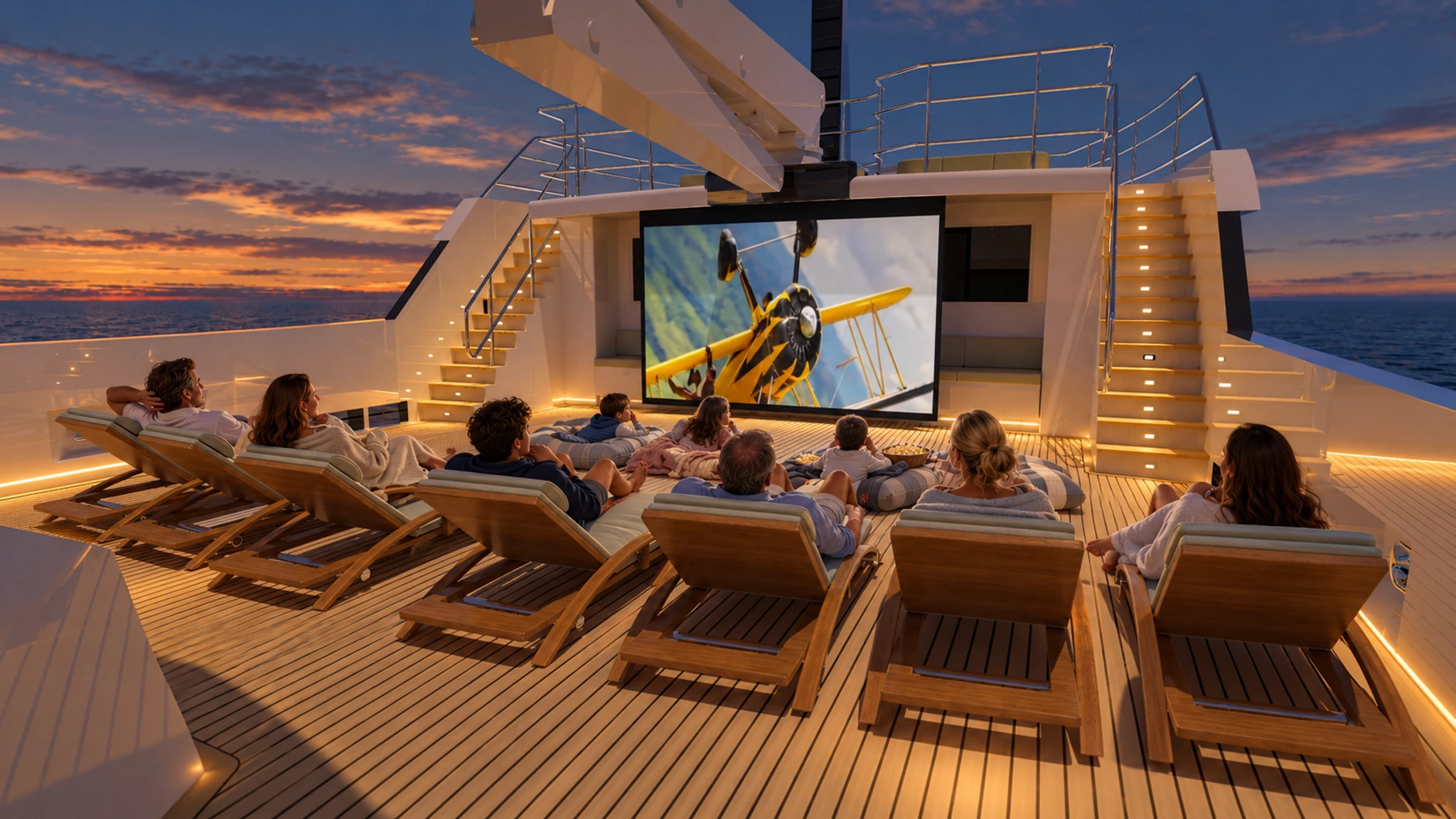
For all the technical complexity behind his vessels, Overing believes their ultimate purpose is deeply human. A yacht creates the setting in which families travel together, children discover the sea, friendships deepen, and ordinary moments become lifelong memories.
The yacht is the vessel.
The memories are the destination.